
5 Challenges in Esports Facility Expansion
- Zoning and Regulations: Local zoning laws often classify esports venues like sports arenas, requiring added parking, specialized infrastructure, and compliance with unique codes.
- High Tech Costs: Building esports venues demands hefty investments in gaming hardware, network infrastructure, and production setups, often exceeding $600,000.
- Funding Struggles: Convincing investors can be tough due to esports' newness. Diversified revenue streams and data-backed proposals are key to gaining trust.
- Underutilization Risks: With competition from home gaming setups and other venues, ensuring consistent foot traffic is a challenge.
- Complex Growth Management: Scaling operations while maintaining quality requires phased growth, flexible infrastructure, and support for players and staff.
Quick Tip: Tools like CoreCast help developers streamline zoning, funding, and operational planning with data-driven insights.
These challenges demand a mix of planning, smart investments, and creative solutions to make esports facilities successful in an evolving market.
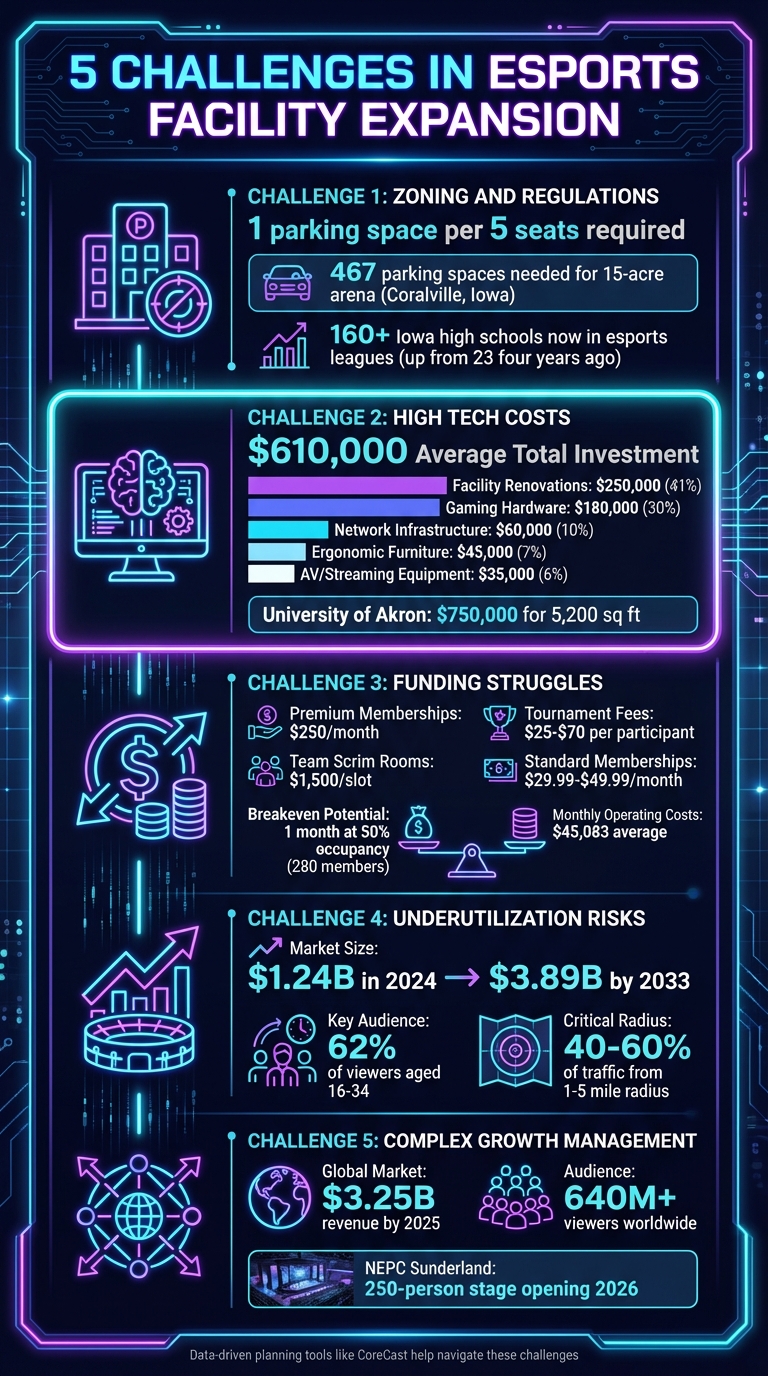
5 Key Challenges in Esports Facility Expansion with Cost Breakdown
Challenge 1: Zoning and Regulatory Hurdles
Zoning Restrictions and Location Regulations
Esports facilities often encounter zoning challenges that differ from those faced by traditional sports venues. For instance, local governments frequently classify these venues as "sports facilities", which triggers specific requirements like parking ratios. Take Coralville, Iowa, as an example: the city mandates one parking space for every five seats. When the Coralville City Council approved a master development site plan for a 15-acre esports arena near Interstate 80 in February 2026, the plan had to include 467 parking spaces to meet this requirement [5].
But parking isn't the only concern. These facilities require specialized infrastructure that doesn't align with standard zoning codes. High-speed internet, robust data centers, significant power capacity, and flexible spaces for massive screens and modular seating are just the start [1][6]. Developers also need to accommodate unique spaces like production studios, control rooms, and areas for player drug testing or rehabilitation. These specialized needs often fall under separate regulatory codes compared to typical commercial buildings [1].
Working with Local Authorities
Engaging with zoning boards and local governments early in the process can make or break a project. In Coralville, City Administrator Kelly Hayworth oversaw a phased development plan for the esports arena. By starting with retail and restaurant buildings in summer 2026, the project was able to address regulatory and financial challenges step by step [5].
Highlighting community benefits can also help build local support. Esports' growing popularity in Iowa is a great example, with over 160 high schools now participating in esports leagues - up from just 23 schools four years ago. Levi LaRue, President of the Iowa High School Esports Association, emphasized the significance of such projects:
"It's really cool seeing one being built. It will help legitimize esports and the work that high schools and colleges in Iowa have been doing for a number of years" [5].
However, developers should be ready for public opposition, particularly from groups resistant to new developments in their neighborhoods. "Not In My Back Yard" (NIMBY) sentiments often emerge during public meetings, in online forums, and through local media [7]. Monitoring these channels and addressing concerns early can help avoid costly delays.
Using Data for Compliance Planning
Real estate intelligence platforms can simplify the zoning approval process by offering data-driven insights. For example, CoreCast helps developers map competitive landscapes, assess regulatory environments across markets, and predict potential challenges before committing to a site. By consolidating zoning, demographic, and market data, developers can pinpoint locations with favorable regulations and build stronger cases for approval.
CoreCast’s mapping tools are particularly useful for visualizing factors like proximity to tech hubs, military bases, and schools - key demographics for esports facilities [3]. These tools also help quantify risks like "entitlement risk" and "time-to-approval risk", giving developers a clearer picture of what to expect [7]. With well-prepared, data-backed proposals, developers stand a better chance of securing approvals on their first attempt.
Once zoning challenges are addressed, developers can shift their focus to tackling the costs and complexities of building high-tech infrastructure.
sbb-itb-99d029f
eSports Arena Design | The Design Problem (Part 3)
Challenge 2: High Technology Infrastructure Costs
After navigating zoning and regulatory complexities, the next hurdle lies in managing the hefty costs of technology infrastructure.
Calculating Initial Investment Requirements
Building a professional esports facility demands a substantial upfront investment - far beyond just gaming setups. On average, such a project requires $610,000 in total investment [8][10]. Here's how that breaks down:
- $250,000 for facility renovations: Upgrades like specialized electrical systems and high-capacity HVAC units are essential to handle the heat generated by high-performance gaming equipment.
- $180,000 for gaming hardware: This includes professional-grade PCs and high-refresh-rate monitors.
- $60,000 for network infrastructure: Redundant fiber connections and enterprise-grade switches are key to maintaining reliable performance.
- $45,000 for ergonomic furniture: High-quality seating and desks are crucial for player comfort during long sessions.
- $35,000 for audio-visual and streaming equipment: These tools are vital for broadcasting events and enhancing the overall experience.
Take the University of Akron as an example. In 2018, they built 5,200 square feet of gaming spaces, investing approximately $750,000. To help cover these costs, they partnered with Audio-Technica, which contributed headsets, commentator equipment, and $5,000 in scholarships [9].
Cost Reduction Strategies
There are ways to manage these expenses without compromising quality. For instance:
- Leasing gaming hardware can help maintain cash flow while enabling upgrades every three years [10][11].
- Securing tenant improvement (TI) allowances can reduce renovation costs by as much as $150,000 to $250,000 [11].
- Strategic sourcing plays a big role. Buying certified refurbished network switches can cut networking hardware costs by 20% while maintaining performance [10]. Similarly, starting with 1080p/60fps streaming gear instead of jumping straight to 4K can save money, with the option to rent high-end equipment for major events [10].
- Negotiating volume discounts for bulk purchases of PCs or chairs (50+ units) directly with commercial distributors can also lead to significant savings [8][10].
Modeling ROI with Data Tools
Assessing the return on investment (ROI) for esports facilities involves analyzing various revenue streams and deployment scenarios. Platforms like CoreCast simplify this process by consolidating cost estimates, revenue forecasts, and market data. For example, some facilities have achieved breakeven in as little as one month by reaching 50% occupancy with 280 members [10].
Monthly operating costs for a professional facility typically average $45,083, which includes $12,000 for leasing and $29,583 for payroll [10]. By combining these fixed costs with revenue from sources like premium memberships ($250/month), team scrim room rentals ($1,500/slot), and additional sales, developers can craft detailed, data-backed proposals for investors [10][12]. CoreCast also supports these efforts with polished, professional-grade presentations to share with stakeholders.
With a clearer understanding of technology costs, the next step is securing the funding to bring these plans to life.
Challenge 3: Securing Funding and Investment
After tackling zoning issues and the high costs of advanced technology, the next big challenge is securing funding. Even with a solid financial plan, convincing investors to back esports facilities can be tough. The industry's relative youth and perceived risks often make traditional investors wary, despite its rapid growth and potential.
Building Investor Confidence
To win over hesitant investors, you need to show clear, measurable demand. Hosting local tournaments or watch parties is a great way to generate interest and document market activity. Grassroots movements, like the rise of high school esports programs, also reinforce the idea that the market is growing.
A diversified revenue model can make your proposal more appealing. Consider income streams like:
- Memberships ($29.99 to $49.99 per month)
- Tournament fees ($25 to $70 per participant)
- Concessions and retail sales
- Hosting private events
The idea is to go beyond esports alone. As Craig Janssen, Managing Director at Idibri, points out:
"You can't fund a cool esports space by esports alone."
Facilities that can double as venues for comedy shows, concerts, or corporate meetings bring in steady revenue, which is exactly what investors want to see.
Demographics also play a key role in building confidence. Esports primarily attracts viewers aged 16 to 34, a group that makes up 62% of the audience. Many in this demographic earn over $100,000 annually [3], making them attractive to sponsors outside the gaming world, like Nike, Toyota, and Mastercard. Combining this audience profile with diversified income strategies creates a strong foundation for investor pitches.
Creating Data-Driven Investor Proposals
Investors today expect proposals backed by data. Platforms like CoreCast can simplify this process. They combine market analysis, revenue forecasting, and competitive insights into a single, polished proposal. CoreCast also offers tools to track your project through each funding stage, analyze multiple potential locations, and produce professional reports for stakeholders.
One standout feature is its integrated mapping tool, which helps identify prime locations near high schools, colleges, or tech hubs - areas where your target audience is most concentrated. The platform’s pipeline tracking ensures every step, from concept to funding, is organized and efficient. This turns scattered data into a clear, compelling case for both short-term returns and long-term growth.
Once funding is secured, the focus shifts to ensuring the facility remains busy and profitable.
Challenge 4: Facility Underutilization and Market Saturation
Even with funding secured, keeping esports venues consistently occupied is a major hurdle. The esports venue market reached $1.24 billion in 2024 and is expected to grow to $3.89 billion by 2033. However, competition is heating up - not just from other venues but also from the comfort of home gaming setups [13]. Traditional sports arenas are being retrofitted to host esports events, while dedicated esports venues are popping up across the country.
The biggest competitor? Home setups. With high-quality monitors, fast internet, and ergonomic chairs, many fans prefer gaming or watching tournaments from their living rooms rather than spending money on event tickets. As Chris Hopper, Head of Esports North America at Riot Games, put it:
"There is a consistent demand to draw people, but we don't know how much that can scale night in and night out" [1].
Assessing Market Demand
Before committing to a lease, it’s crucial to understand the market demand in your area. Most of your traffic - 40% to 60% - will come from within a 1- to 5-mile radius of your facility [14]. Tools like CoreCast can help you map this catchment area and analyze nearby competition. Their platform identifies key locations like high schools, colleges, and tech employers, giving you a clear picture of where your primary audience - 18- to 34-year-olds - is concentrated.
Testing the waters with pop-up events and tournaments is a smart way to validate demand. Track metrics such as attendance, time spent at the venue, and secondary sales like food and merchandise purchases. This approach provides real, actionable data before making long-term commitments. CoreCast’s pipeline tracking tool can help you organize these events and measure results across different locations, turning scattered findings into clear insights. These insights can guide decisions on how to diversify offerings and stay competitive.
Expanding Facility Use Cases
Once market demand is confirmed, the next step is creating spaces that can adapt to more than just esports tournaments. The most successful venues are designed with flexibility in mind. Features like modular seating, movable bleachers, and adjustable stages allow for a seamless transition between esports events, concerts, comedy shows, and even corporate functions [1][2]. This multipurpose approach significantly boosts revenue potential.
To keep the venue active between major events, consider community-focused programming. Host weekly local tournaments, university matches, or viewing parties. Partner with schools to offer educational programs or STEM workshops. Adding creator suites for influencers to stream live from your venue can also extend your reach beyond physical attendees [2]. Other options include corporate team-building events, product launches, and private parties. The goal is to generate revenue every day, not just during headline events.
Challenge 5: Managing Program Growth and Operations
Once you've tackled zoning, technology, and funding, the next challenge is managing daily operations while scaling up. The global esports market is projected to generate $3.25 billion in revenue by 2025, with an audience exceeding 640 million viewers worldwide [4]. Without strong operational systems, growth can quickly lead to burnout, technical problems, and low attendance. The solution? Build systems that can support growth without overloading your team or budget.
Scaling Operations in Phases
Successful scaling starts with small, manageable steps. Instead of going all-in, smart operators begin with smaller events like 100-player local tournaments or fan viewing parties to test the waters and identify operational weak spots [4]. This phased approach allows you to refine processes - such as check-in systems and network capacity - before committing to larger-scale events. By starting with smaller initiatives, you reduce risks and better manage resources.
Flexibility is key when scaling. Modular infrastructure - like adjustable stage desks, removable seating, and configurable stage setups - lets you adapt your venue for anything from intimate 1v1 matches to large 5v5 tournaments [4][2]. Hybrid production models can also extend your reach, combining remote casters, cloud encoding, and local feeds to cater to both in-person and online audiences [2]. These strategies ensure your operations can grow without requiring constant overhauls.
Once your operations are scalable, the focus shifts to creating an environment where athletes and staff can thrive.
Supporting Athlete and Staff Wellbeing
Esports athletes and staff face unique demands that traditional sports venues may not address. Modern facilities are stepping up by including player lounges equipped with ergonomic seating, snacks, and private spaces for strategy discussions [4]. For example, the National Esports Performance Campus (NEPC) in Sunderland, UK, scheduled to open its gaming arena in 2026, will feature a 250-person stage and also serve as a training center for skills like stagecraft, health, and nutrition [15]. Virginia Caldo, COO of GiantX, highlights this broader mission:
"Esports sit at the intersection of technology, creativity, and youth culture... Investing in structured programmes and accessible spaces helps bridge the gap between play and profession" [15].
To prevent burnout, many organizations implement academy rosters - secondary teams that allow primary players to rest while maintaining competitive momentum [16]. For staff, adopting practices from traditional sports, such as structured shift schedules and specialized training in areas like AV operations and crowd management, can alleviate fatigue [2]. Nottingham Trent University's expansion of its esports program - transforming basic PC rooms into a full production gallery and studio - has shown how focusing on the live events side of esports can prepare graduates for careers with major companies [15].
With a solid operational foundation and a supportive environment, the next step is leveraging technology to streamline event management.
Using Technology to Manage Operations
Technology is a cornerstone of efficient operations, especially as you expand. Reliable network infrastructure is critical - using VLANs, dual ISPs, and UPS systems ensures events run smoothly without unexpected disruptions [4]. A single technical hiccup can derail an entire event, making robust connectivity a non-negotiable priority.
Platforms like CoreCast simplify the complexities of scaling up. CoreCast helps operators track deal stages, organize pop-up events across multiple locations, and measure performance in real time. It consolidates operational data - from site selection to event outcomes - into a single platform, providing actionable insights. Features like an integrated map help you assess your facility's position in the competitive landscape, while portfolio analysis tools highlight which programs are driving revenue and which need tweaking. With third-party integrations and advanced pipeline tracking, CoreCast turns scattered data into clear strategies, allowing you to grow efficiently without overextending your resources.
Conclusion
Expanding an esports facility comes with five main challenges: zoning and regulatory complexities, the high costs of advanced technology infrastructure, securing funding and investment, avoiding facility underutilization and market saturation, and managing program growth and operations. These hurdles shape the future of esports facilities across the U.S., where success depends on adaptability and smart use of data. Zoning issues can be tackled with creative redevelopment strategies and proactive engagement with regulators. Technology costs? They’re best managed by focusing on phased investments and ROI modeling. To attract funding, present compelling viewership data and solid revenue forecasts. Market saturation can be avoided by designing spaces that serve multiple purposes - think gaming tournaments, concerts, comedy nights, and community events. And when it comes to scaling operations, modular infrastructure and a focus on athlete wellbeing are critical from the start.
Data-driven solutions make all the difference. Platforms like CoreCast simplify the process, providing tools that consolidate everything from site selection to performance metrics and portfolio analysis. This kind of streamlined intelligence helps you make smarter decisions at every stage of expansion.
Esports and real estate are blending into a new era of audience engagement and experiential design. Adam Ducker, Managing Director at RCLCO Real Estate Advisors, captures this shift perfectly:
"If we look out five years from now, there will be an esports facility in every major city" [1].
With thoughtful planning, the right technology, and robust data tools, your facility can become more than a venue - it can be a cornerstone of community development. By prioritizing integration into the local real estate ecosystem, esports facilities can attract millennial and Gen Z audiences while driving urban renewal. It’s about creating community-first spaces that resonate with today’s digitally connected world.
FAQs
What zoning issues should I check before choosing a site?
Before diving into development, it's crucial to review local zoning laws. Make sure the site is approved for entertainment or recreational use. Verify that there are no restrictions specifically targeting the construction of esports arenas. Tackling this early can help you sidestep legal or operational headaches down the road.
How can I lower the upfront tech buildout cost?
To keep initial tech buildout costs in check for an esports facility, focus on creating a design that accommodates future needs, reducing the risk of costly updates down the line. Renovating an existing building can be a more budget-friendly option compared to starting from scratch, but it's important to keep renovation costs under control. Concentrate on essential technology rather than splurging on premium upgrades, and consider implementing upgrades in phases with a well-defined budget. Smart planning helps ensure resources are used wisely without exceeding financial limits.
How do I keep an esports venue busy between major events?
To keep an esports venue buzzing, it’s all about variety. Organize gaming sessions, tournaments, watch parties, and community-centered events to keep people coming back. Build loyalty by offering memberships, training programs, and casual gaming nights where players can relax and connect.
You can also branch out by hosting educational workshops, selling merchandise, or arranging sponsorship activations. These additions not only engage your audience but also create extra revenue streams. A flexible venue setup ensures there’s always something happening, even when major tournaments aren’t on the schedule.